
A few years ago, searching for a new laptop meant opening several websites, comparing specifications, reading reviews and trying to work out which model offered the best value. Today, you can ask an AI-powered search tool to compare laptops for graphic design under a specific budget, explain the differences between their processors and identify which features matter most for your needs.
The information still comes from the web, but the experience is changing. Instead of starting with a list of links and doing all the research yourself, you can now begin with a generated answer, ask follow-up questions and narrow your options through a conversation.
This shift is changing more than the search experience. It is affecting how people research products, how businesses attract customers and how marketers think about online visibility. Traditional search is evolving into something more conversational, contextual and increasingly capable of handling complex tasks.
What Is the Difference Between Traditional Search and AI-Powered Search?
Traditional search engines retrieve and rank information from websites, videos, images and other indexed content. When you enter a query, the search engine attempts to identify relevant results and present them in an order that helps you find what you need.
AI-powered search adds another layer. Instead of presenting only a list of results, it can interpret a question, synthesise information from multiple sources and generate a response in natural language. Some systems also support follow-up questions, visual inputs and more complex research tasks.
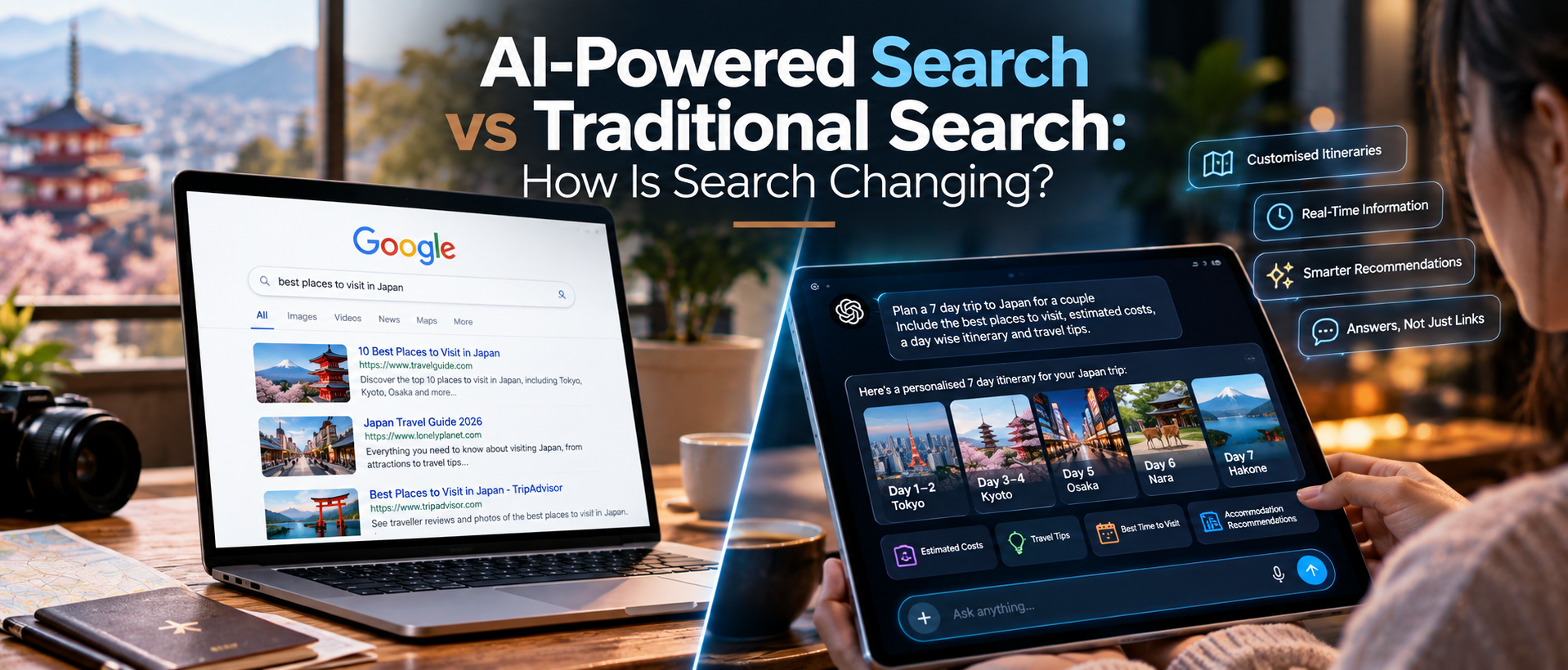
Consider a search for the best places to visit in Japan in November.
A traditional search might return travel guides, destination pages, weather information and articles about autumn foliage. You would open several results, compare the advice and build your own itinerary.
An AI-powered search experience could provide an initial destination comparison, explain seasonal differences and suggest an itinerary based on your interests. You could then ask it to adjust the plan for a family trip, a limited budget or a preference for less crowded destinations.
The distinction is not that one system finds information while the other does not. Both can retrieve information. The difference lies in how the results are organised, presented and explored.
| Traditional search | AI-powered search |
| Primarily presents ranked links and specialised search features | Can generate direct answers alongside links |
| Often works well with concise keywords | Handles detailed, conversational questions |
| Users generally compare information across different pages | Can synthesise information from multiple sources |
| Follow-up searches often require a new query | Supports conversational follow-up in many interfaces |
| Users do much of the interpretation themselves | AI can help compare, summarise and explain |
| Primarily retrieves information | Some systems can also assist with planning and actions |
These categories are not entirely separate anymore. Google, for example, combines conventional search results with AI Overviews and AI Mode. Traditional search engines are incorporating AI, while AI assistants increasingly retrieve information from the live web.
Search Is Moving Beyond Keywords
One of the most noticeable changes is the way people formulate their searches.
Traditional search encouraged users to reduce a question to a few important words. Someone researching a holiday might enter phrases such as:
- Affordable hotels in Bangkok
- Best time to visit Japan
- Colombo to London flights
- Things to do in Singapore
These short queries remain useful, especially when the user knows exactly what they want.
AI-powered search makes it easier to ask something more specific:
I’m planning a seven-day trip to Japan in November with my parents. We enjoy food, nature and cultural experiences, but we want to avoid changing hotels too often. Can you suggest an itinerary that keeps travel time manageable?
That request contains several conditions. A conversational system can interpret them together and produce a starting point without requiring the user to conduct a separate search for every detail.
Google’s January 2026 updates to AI Overviews introduced more seamless follow-up conversations, allowing users to move from an initial answer into deeper exploration. Its May 2026 announcements also described more flexible search inputs, including text, images, files and videos in supported experiences.
For businesses, the implication is significant. Content needs to answer questions in context, not merely target isolated keywords. A page that addresses a customer’s actual problem may be more useful than one that repeats a search phrase without offering meaningful information.
From Finding Links to Getting Answers
The traditional search experience gives users a degree of control over how they investigate a subject. They can choose which websites to open, compare conflicting information and decide which sources they trust.
AI-powered search changes the first step by presenting a summary before the user visits individual websites.
This is convenient when someone wants a quick explanation. A person asking about the difference between OLED and QLED televisions, for instance, may benefit from a concise comparison before exploring specific models.
But generated answers introduce a different responsibility. The system has to select and interpret information accurately, and the user needs to understand where the answer came from.
A fluent response can still contain outdated details, missing context or incorrect claims. This is particularly important for topics involving financial decisions, health, legal requirements, technical specifications and rapidly changing information.
A direct answer saves time, but it does not remove the need to evaluate the information.
That is why citations and source links matter. Google’s AI search updates in 2026 have included efforts to make original websites, articles and firsthand perspectives easier to discover from AI-generated responses. The intention is to connect quick answers with further exploration rather than make the web irrelevant.
For users, this means treating an AI-generated response as a useful starting point, especially when the decision carries meaningful consequences.
Why AI Search Is Changing the Customer Journey
A customer researching a product rarely follows a perfectly straight path from awareness to purchase.
Someone might discover a phone through a creator’s video, search for its specifications, ask an AI tool to compare it with a competitor, read customer reviews and then visit a retailer to check the price.
AI-powered search can compress parts of this process. Instead of opening several pages to understand the differences between two products, a user can request a comparison and follow up with more specific questions.
Google’s January 2026 research on AI-powered search behaviour describes increasingly detailed queries and more fluid movement between discovery, research and purchase decisions. Its findings reflect Google’s own observations, rather than a universal measurement of every search platform or market.
For businesses, this creates both opportunities and challenges.
A company may receive fewer visits from people looking for simple definitions because an AI summary provides the information directly. However, people who do click through may be looking for deeper product information, original research, detailed comparisons or a specific service.
That makes the quality and purpose of website traffic increasingly important. A business should look beyond visitor volume and examine whether its content attracts people who are genuinely interested in what it offers.
What Happens to SEO When AI Search Becomes More Common?
Search engine optimization is not disappearing. Its role is expanding.
Traditional SEO focuses on helping search engines discover, understand and rank content that is relevant to a user’s query. Technical accessibility, useful content, internal links, credible references and a clear site structure remain important.
AI-powered search adds another consideration: whether content can contribute meaningfully to a generated answer.
This has encouraged discussion around Generative Engine Optimisation (GEO) and Answer Engine Optimisation (AEO). These terms describe approaches to improving the visibility and usefulness of content in AI-generated answers and question-based search experiences. They do not represent a guaranteed formula for appearing in AI responses.
A practical strategy should include the following:
Write clear, direct explanations. Answer the central question early, then provide the evidence, context and detail needed to support the answer.
Organise content around user intent. A person comparing two services needs more than a general introduction to each service. They need meaningful differences, relevant costs, limitations and criteria for making a decision.
Include original information. Research, first-hand experience, expert commentary, case studies and useful data give readers a reason to visit the source rather than settle for a generic summary.
Make important details easy to identify. Descriptive headings, accurate product information, structured data where appropriate and clearly labelled sections help both readers and search systems interpret a page.
Maintain credibility. Cite reliable sources, identify relevant expertise and keep information current, especially when prices, policies or technical details change.
Google’s guidance on AI features in Search continues to emphasise the importance of helpful, accessible content rather than requiring a separate technical optimisation system specifically for AI Overviews. Businesses should therefore strengthen their existing SEO foundations while adapting content to more conversational search behaviour.
AI Search Creates a New Challenge for Website Traffic
One of the biggest concerns for publishers and businesses is whether AI-generated answers will reduce clicks to websites.
The concern is understandable. If someone asks a simple question and receives a satisfactory response directly in the search results, there may be little reason to open another page.
For example, a search for the meaning of a common technical term may be answered in a few sentences. A detailed comparison of insurance policies, on the other hand, may require users to explore exclusions, conditions, prices and provider information that cannot be fully understood through a short summary.
The impact will therefore differ by content type, industry, query and search interface.
Google’s August 2025 statement reported that overall organic click volume from Google Search to websites was relatively stable year over year at that time. The company also reported that some visitors arriving through AI search experiences were more likely to engage with the websites they selected. These are Google’s own measurements and should not be treated as proof that every publisher or business has experienced stable traffic.
Businesses should monitor their own performance rather than assume that AI search will either destroy organic traffic or automatically improve its quality.
Useful indicators include:
- Organic impressions and clicks
- Traffic from AI search referrals where measurable
- Branded search activity
- Engagement with important landing pages
- Product enquiries and qualified leads
- Conversions from organic traffic
- Search visibility for high-intent questions
A decline in visits to a basic informational page may have a different business impact from a decline in traffic to a product comparison or service enquiry page. Understanding that difference is essential when deciding where to invest in content.
AI Search Is Becoming Multimodal
Search is no longer limited to typing words into a box.
People increasingly use images, voice and other forms of input to find information. Someone can photograph a plant to identify it, use a picture to find a similar product or ask a question about an image on their screen.
Google Lens and Circle to Search are examples of visual search experiences. Google’s January 2026 overview of consumer search behaviour reported that one in five Google Lens searches had commercial intent, based on Google’s internal data. That figure is specific to Lens and should not be interpreted as a measurement of all visual searches.
For brands, visual discovery creates a practical content requirement. Product images should be accurate, useful and supported by relevant descriptions. Retailers should make specifications, availability and product variants easy to understand. Travel businesses can benefit from clear destination imagery accompanied by genuinely helpful information about locations, seasons and experiences.
The opportunity is not simply to add more images to a website. It is to make sure that visual content helps people identify, understand and evaluate what they are seeing.
Traditional Search Still Has Important Advantages
The growth of AI-powered search does not make conventional search obsolete.
A list of results is often useful when users want to explore different perspectives rather than receive one synthesised answer. Researchers may need to inspect original papers. Journalists may want to compare reporting from multiple publications. Consumers may prefer to read detailed reviews and visit retailer websites themselves.
Traditional search also gives users a familiar way to locate specific websites, find official sources and explore a topic without relying on a single generated summary.
AI-generated responses can make research more efficient, but the underlying source material remains essential. When the accuracy of an answer matters, being able to inspect the original document or website is a major advantage.
This is particularly relevant for businesses that publish original research, specialist knowledge or detailed product information. Their content can serve as a primary source for readers and potentially contribute to AI-generated answers, provided the relevant search systems can access and select it.
What Should Businesses Do Differently in 2026?
The most useful response is not to abandon traditional SEO or publish a large volume of AI-generated articles. Businesses should first understand how their customers search and what information helps them make decisions.
A company selling software, for example, might discover that its customers search for specific integration problems, pricing differences and implementation requirements. A travel business may find that customers want realistic itineraries, seasonal advice and comparisons between destinations. A retailer may need detailed product specifications, availability information and answers to common buying concerns.
These are content opportunities because they address real decisions.
A practical starting point is to review the existing content library and identify pages that offer little beyond general definitions. Improve them with specific examples, original information, useful comparisons and clear answers to related questions. Then create new content around the questions that customers repeatedly ask sales teams, support staff and online communities.
Businesses should also make sure their important information is accessible. Search visibility depends in part on whether systems can discover and interpret the content, while accurate product and service details are essential when users rely on AI tools to compare options.
Most importantly, do not measure success only by whether a brand appears in an AI-generated response. Visibility matters, but it should connect to a meaningful outcome: informed visitors, qualified enquiries, stronger brand recognition or sales.
The Future of Search Is Likely to Be a Combination of Both
The distinction between AI-powered search and traditional search is becoming less clear.
Search engines are adding conversational answers, follow-up questions and more sophisticated ways to explore information. AI assistants are connecting to search indexes and external sources. Some systems are also moving beyond research toward actions such as planning, booking or completing tasks, subject to their available capabilities and permissions.
This does not mean every search will become a conversation. A person looking for a company’s official website may still prefer a simple result. Someone comparing several complex options may appreciate an AI-generated explanation before reviewing the original sources.
The future is likely to involve both experiences working together: conventional retrieval when users want to locate information, and AI assistance when they need help understanding, comparing or acting on it.
For businesses, that means the fundamentals remain familiar even as the interface changes. Useful information, trustworthy sources, accessible websites and a clear understanding of customer intent continue to matter.
Search is changing from a process of finding pages toward an experience that can help people make sense of information. Brands that understand the difference will be better prepared to create content that serves customers, whether they arrive through a traditional results page, an AI-generated answer or a conversational search experience.
The goal is not simply to be found. It is to be worth finding.