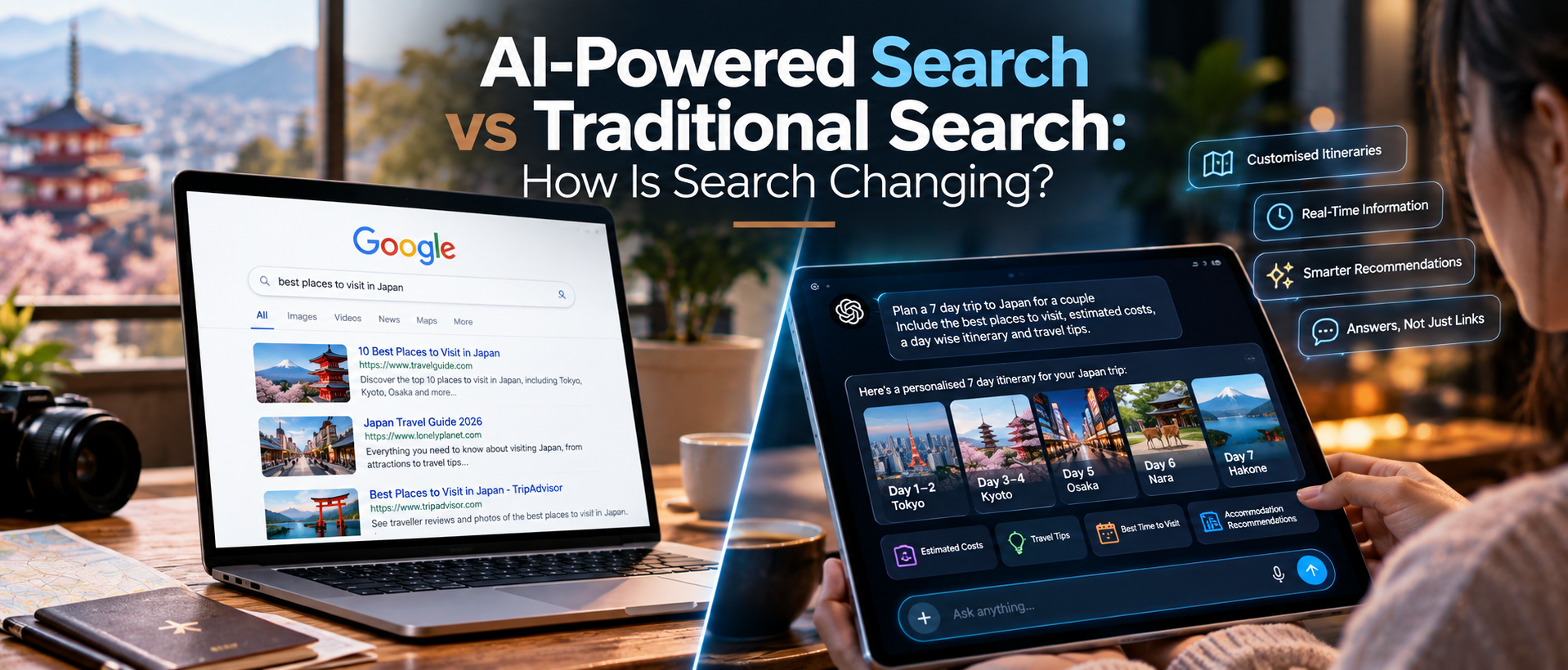

Search is changing. For years, brands competed for visibility by optimizing web pages for traditional search engines, targeting keywords, building backlinks, improving technical SEO and trying to reach the top of Google’s results page.
Now, people are increasingly asking questions directly to AI-powered search experiences.
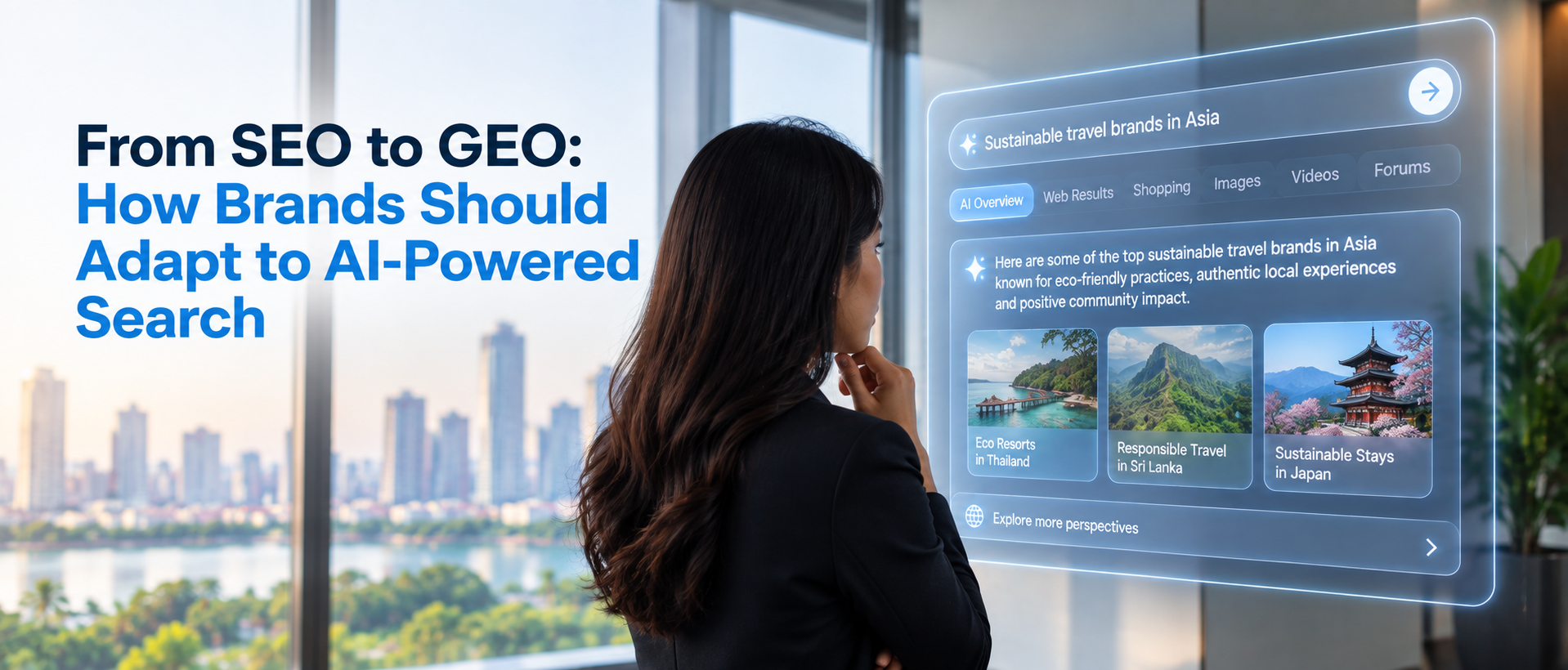
Instead of searching for ten different pages and comparing the results themselves, users can ask an AI system a detailed question and receive a synthesized answer with links to supporting sources. Google’s AI Overviews and AI Mode, along with AI search experiences such as ChatGPT Search, are changing how people discover information online. Google says AI Mode queries have more than doubled every quarter since launch, while AI Overviews now reach more than 2.5 billion monthly active users.
This does not mean SEO is disappearing.
It means brands need to think beyond traditional rankings.
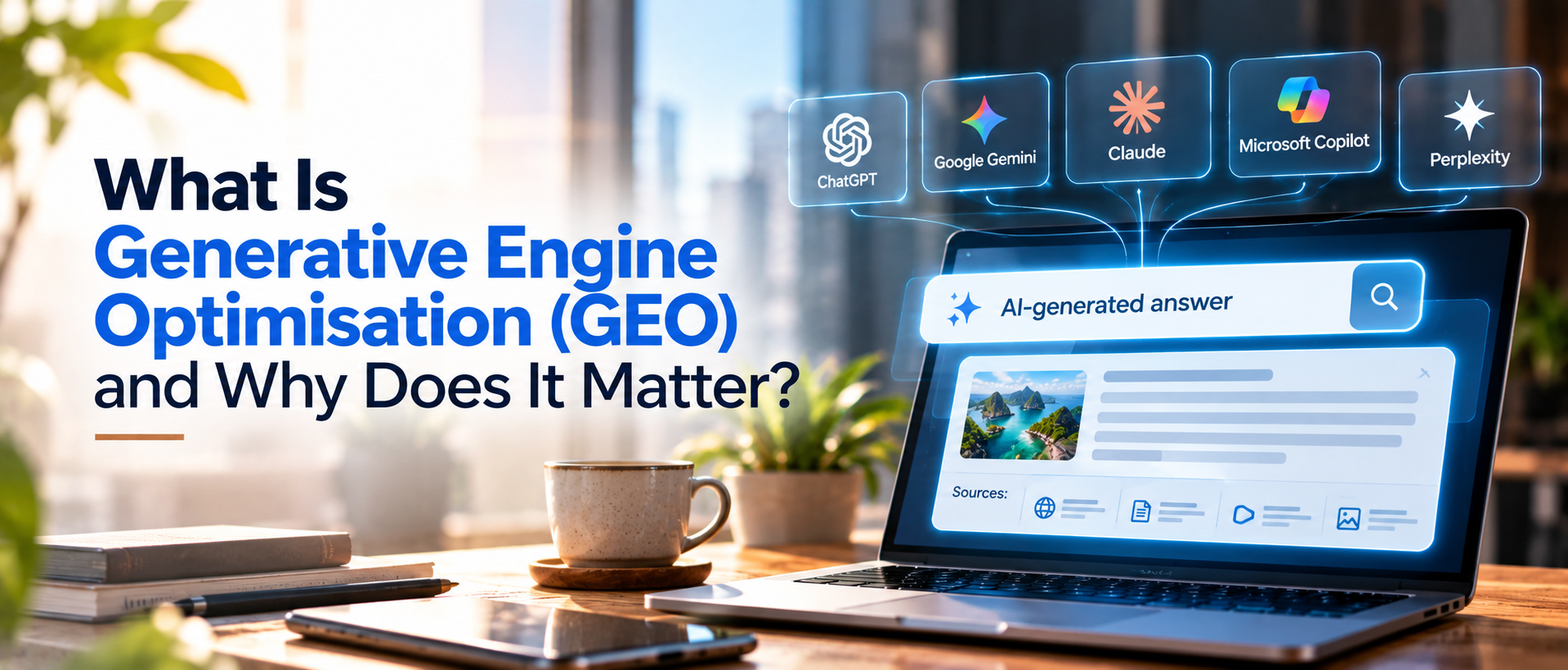
That is where Generative Engine Optimization, or GEO, has become increasingly relevant.
What Is GEO?
Generative Engine Optimization refers to the process of creating and structuring content so that it can be more effectively discovered, understood, cited or referenced by AI-powered search and answer systems.
Traditional SEO generally focuses on questions such as:
- What keywords are people searching for?
- How can this page rank higher?
- How can we improve organic traffic?
- Which websites are linking to us?
GEO adds another layer:
- Can AI systems clearly understand what our brand does?
- Does our content directly answer the questions people ask?
- Are our claims supported by credible information?
- Is our brand mentioned consistently across relevant sources?
- Can an AI system identify our expertise and use our content as a source?
The important distinction is that GEO is not a secret technical formula for getting mentioned by AI.
Google’s own guidance says there are no additional technical requirements or special schema required specifically for AI Overviews or AI Mode. Existing SEO fundamentals remain important.
GEO is therefore better understood as an evolution in how brands approach search visibility rather than a replacement for SEO.
SEO vs GEO: What Has Changed?
Traditional search usually presents a list of links. The user decides which pages to open and combines information from multiple sources.
AI-powered search can perform more of that interpretation before presenting the answer.
For example, someone might previously search:
“Best CRM software for small businesses”
With traditional SEO, brands would compete to rank for that keyword.
An AI-powered search user might instead ask:
“I run a 20-person B2B company and need a CRM with automation, email integration and a reasonable monthly cost. Which options should I consider?”
The second query contains context, preferences and multiple requirements.
This creates a different visibility challenge.
A brand does not simply need to rank for one keyword. Its content needs to provide sufficiently useful, clear and trustworthy information that an AI system can understand and potentially reference when answering related questions.
Why AI Search Is Changing Search Behaviour
AI search is making queries more conversational and detailed.
Google has reported that people are asking increasingly complex and longer questions through its AI search experiences. Its newer AI Search features are designed to support follow-up questions, deeper exploration and more conversational interactions.
This changes the opportunity for brands.
Instead of building content around isolated keywords, businesses should increasingly understand the questions, problems, comparisons and decisions surrounding their products or services.
For example, a cybersecurity company should not only target:
“cybersecurity services”
It could also create useful content around:
- How much cybersecurity does a small business need?
- What should a company look for in a cybersecurity provider?
- What is the difference between MDR and MSSP?
- How does endpoint detection work?
- What cybersecurity risks should remote businesses consider?
- How often should companies conduct security assessments?
The goal is to build topical depth around the problems customers actually need to solve.
1. Create Content That Answers Specific Questions
One of the biggest changes brands should make is moving away from content created primarily around keyword volume.
Keywords still matter. But the underlying search intent matters more.
A useful GEO-focused article should answer the question quickly and then provide the supporting context.
For example, instead of starting an article about cloud migration with several paragraphs of generic background, begin by answering:
“How long does cloud migration take?”
Then explain the factors that affect the timeline, provide realistic scenarios and identify circumstances that could make the process longer or shorter.
This makes the content useful to a human reader and easier for search systems to understand.
Google continues to emphasize helpful, reliable, people-first content rather than content created primarily to manipulate rankings.
2. Build Topic Authority, Not Just Individual Rankings
A brand’s visibility should not depend on a handful of isolated articles.
Suppose a company sells AI automation services.
Instead of publishing one article targeting “AI automation,” it could develop a content ecosystem covering:
AI automation
→ AI agents
→ workflow automation
→ AI customer service
→ AI sales automation
→ AI document processing
→ AI data analysis
→ AI implementation costs
→ AI security
→ AI governance
→ AI automation case studies
This creates a deeper knowledge base around the company’s area of expertise.
The objective is not simply to publish more content.
It is to publish connected, useful content that demonstrates genuine expertise.
3. Make Your Content Easy for AI Systems to Understand
AI systems need to interpret web content before they can potentially use it.
That makes clarity important.
Brands should structure pages with:
- Clear headings
- Direct answers
- Descriptive titles
- Short explanatory sections
- Useful tables where appropriate
- Definitions of technical terms
- Supporting evidence
- Relevant internal links
- Clear author and company information
- Accurate structured data where applicable
This does not mean writing specifically for machines at the expense of people.
In fact, many of these practices improve the experience for human readers too.
Google recommends making important content available in textual form, maintaining crawlability, using internal links and ensuring structured data matches visible page content.
4. Strengthen Your Brand’s Entity Presence
Traditional SEO often focuses heavily on individual pages.
GEO makes the broader identity of a brand increasingly important.
AI systems need to understand relationships between entities.
For example:
Refcoins → digital solutions → AI → technology → marketing → services
A brand should therefore maintain consistent information across its website and relevant external platforms.
Company descriptions, service names, leadership information, locations, product information and areas of expertise should not contradict each other across different sources.
The stronger and more consistent the available information about a brand, the easier it can be for systems to understand what that brand represents.
5. Build Original Information, Not Just Generic Content
This may become one of the most important advantages for brands.
AI systems can summarize information that already exists.
That makes generic content increasingly easy to replicate.
Original information is harder to replace.
Consider the difference between:
“10 Benefits of AI for Businesses”
and:
“What We Learned After Automating 200 Customer Support Requests”
The second article potentially contains firsthand observations, data, implementation details and lessons that cannot simply be recreated by rewriting existing web pages.
Google’s guidance specifically emphasizes valuable, unique and non-commodity content as an important consideration for generative AI search.
Brands should therefore invest in:
- Original research
- Surveys
- Proprietary data
- Case studies
- Expert commentary
- Firsthand experience
- Industry benchmarks
- Original examples
- Customer insights
This is where content marketing and genuine expertise become particularly valuable.
6. Use Statistics and Sources Carefully
AI-generated answers can make information easier to consume, but users still need trustworthy sources.
Brands should make factual claims easy to verify.
Instead of saying:
“AI can significantly improve productivity.”
Explain what was measured, where the figure came from and what conditions applied.
For example:
“In a 2026 internal analysis of 150 customer-service workflows, automation reduced average handling time by X%.”
Then provide the methodology or source.
Credibility matters because AI search systems can use external sources to ground their answers. Google’s documentation describes generative AI features as using techniques such as retrieval-augmented generation to retrieve relevant information from its Search index.
7. Think Beyond Your Own Website
GEO is not purely a website exercise.
AI systems can encounter information about a brand through many sources.
That means businesses should consider their broader digital footprint:
- Industry publications
- News websites
- Business directories
- Professional organizations
- Reviews
- Interviews
- Partner websites
- Research publications
- Social platforms
- Community discussions
- Customer case studies
This does not mean attempting to manufacture mentions everywhere.
It means building a credible presence across the digital ecosystem where customers and industry professionals already exchange information.
8. Don’t Abandon Traditional SEO
This is one of the most important points.
GEO should not become an excuse to ignore SEO.
Google explicitly states that its AI search experiences are built on its existing Search systems and that established SEO practices remain relevant. Pages still need to be crawlable, indexable and eligible to appear in Search.
That means brands should continue investing in:
- Technical SEO
- Site architecture
- Internal linking
- Page speed
- Mobile usability
- Search intent
- Metadata
- Quality backlinks
- Structured data where appropriate
- Helpful content
- Indexability
The strategy is not:
SEO → GEO
It is:
SEO + GEO + strong brand authority
9. Structure Content for Multiple Search Journeys
A single piece of content can now serve several different discovery paths.
For example, an article about AI agents could target:
Traditional search:
“What are AI agents?”
Conversational search:
“How are AI agents different from chatbots?”
Commercial research:
“What should a business consider before implementing AI agents?”
Decision-making:
“Are AI agents worth implementing for a small business?”
Local search:
“AI automation companies in Sri Lanka”
The content strategy should therefore account for different levels of user intent.
A useful content architecture often moves from:
Awareness → Education → Comparison → Evaluation → Decision
This gives search users multiple entry points while building a stronger topical ecosystem.
10. Optimize for Citations, Not Just Clicks
Traditional SEO reporting often focuses on:
- Rankings
- Organic traffic
- Click-through rate
- Conversions
These metrics remain important.
But AI search introduces another consideration:
Is the brand being referenced or cited in AI-generated answers?
Google has introduced generative AI performance reporting in Search Console to provide visibility into impressions from AI features such as AI Overviews and AI Mode. Google says these insights have been rolled out worldwide as of August 31, 2026.
This gives marketers another reason to think about visibility beyond the traditional blue-link result.
However, brands should avoid treating every AI mentioned as a guaranteed traffic source.
An AI answer may satisfy the user’s question without requiring a click.
That makes brand visibility, authority and eventual conversion increasingly important alongside raw traffic.
11. Optimize for Conversational Language
People do not always speak to AI search systems the way they type traditional keywords.
Compare:
Traditional keyword:
“best accounting software”
Conversational query:
“What accounting software would work best for a small business that has five employees and wants automated invoicing?”
The second query contains much more context.
Brands should therefore create content that naturally addresses:
- Who
- What
- Why
- How
- When
- Where
- Cost
- Alternatives
- Advantages
- Limitations
FAQ sections can be particularly useful when they answer genuine customer questions rather than simply adding keywords.
12. Use AI to Improve Content, Not Manufacture Authority
AI tools can help marketers research topics, identify content gaps, analyze search intent and develop content structures.
But there is a difference between using AI as a productivity tool and publishing large volumes of generic AI-generated pages.
Google’s guidance focuses on the quality and purpose of content rather than simply whether AI was used to produce it. Content created primarily to manipulate search rankings can violate Google’s spam policies.
A stronger workflow is:
AI research → human expertise → original insight → expert review → useful content
rather than:
AI prompt → article → publish
The first approach gives the brand an opportunity to add knowledge that already does not exist elsewhere.
What Should Brands Measure?
GEO requires marketers to broaden their measurement framework.
Traditional SEO metrics should remain in place, but businesses can add AI-search visibility indicators where data is available.
| Traditional SEO | GEO / AI Search |
| Keyword rankings | AI answer visibility |
| Organic traffic | AI-generated impressions |
| CTR | Brand citations |
| Backlinks | Third-party mentions |
| Search impressions | Entity visibility |
| Conversions | Assisted discovery |
| Page engagement | Brand searches after AI exposure |
The exact measurement framework will continue to evolve because AI search platforms are still developing their reporting systems.
The important point is to avoid measuring success exclusively through traditional keyword rankings.
A Practical GEO Strategy for 2026
Brands do not need to rebuild their entire digital strategy overnight.
A practical approach can start with five steps.
Step 1: Audit Your Existing Content
Identify your most important pages and determine whether they clearly answer the questions customers are asking.
Step 2: Map Customer Questions
Build a database of questions across the customer journey.
Include informational, comparison, pricing, implementation and troubleshooting questions.
Step 3: Identify Content Gaps
Look for questions your competitors answer but your website does not.
Then look for questions that nobody is answering particularly well.
The second category can create an opportunity for original content.
Step 4: Strengthen Authority
Add original research, expert commentary, case studies, statistics, examples and firsthand experience.
Step 5: Measure and Iterate
Monitor traditional organic performance alongside visibility in AI search experiences where reporting is available.
Google’s introduction of dedicated generative AI performance reporting shows that measurement is already moving in this direction.
The Future of Search Is Not Simply “SEO vs GEO”
It is tempting to describe GEO as the next version of SEO.
The reality is more nuanced.
Search engines are becoming answer engines, while AI assistants are becoming discovery interfaces. At the same time, traditional search results remain important.
Google itself says SEO best practices continue to apply to AI search. ChatGPT Search similarly uses web sources and provides links so users can explore the original material.
The brands that adapt successfully will therefore not abandon traditional search optimization.
They will build content that works across both environments.
That means creating information that is:
Discoverable by search engines.
Understandable by AI systems.
Useful to humans.
Credible enough to reference.
Distinctive enough to remember.
FAQs
What is GEO in digital marketing?
GEO stands for Generative Engine Optimization. It refers broadly to strategies that help brands make their content easier for AI-powered search and answer systems to discover, understand and potentially reference.
Is GEO replacing SEO?
No. GEO should be treated as an extension of search visibility rather than a replacement for SEO. Google says traditional SEO fundamentals remain relevant to AI Overviews and AI Mode.
How can a website appear in AI-generated search results?
There is no guaranteed GEO formula. For Google AI features, a page generally needs to be indexed and eligible to appear in traditional Search, while following technical and content best practices. Google says there are no special AI-specific technical requirements or schema required.
Does structured data help with GEO?
Structured data can help search engines understand page content, but it does not guarantee inclusion in AI-generated results. Google specifically states that structured data should accurately represent visible page content.
Should businesses create separate content specifically for AI search?
Not necessarily. Businesses should focus on creating genuinely useful, well-structured content that answers customer questions. The same high-quality content can serve traditional search users and AI-powered search experiences.
Are backlinks still important for GEO?
Traditional SEO and authority signals remain relevant, but brands should not reduce GEO to a backlink-building exercise. Original information, credible sources, topical expertise and a consistent digital presence are also important.
How should businesses prepare for AI-powered search?
Start by improving technical SEO, mapping customer questions, creating original and useful content, strengthening brand authority, maintaining accurate information across the web and measuring visibility across both traditional and AI search experiences.
Conclusion
The shift from SEO to GEO is not really a shift from one system to another.
It is a shift in how people discover and consume information.
Traditional search asked users to find, open and compare websites. AI-powered search increasingly allows users to ask complex questions and receive synthesized answers supported by information from multiple sources.
For brands, that creates a new challenge.
Being number one for a keyword is no longer the only form of search visibility worth considering.
Brands need to become sources that search engines can discover, AI systems can understand and audiences can trust.
The companies that invest in original expertise, useful information, strong technical foundations and a consistent digital presence will be better positioned as search continues to evolve.
For businesses looking to navigate this transition, GEO should not be treated as another short-term SEO tactic. It should become part of a broader digital strategy focused on authority, usefulness, discoverability and trust.
Refcoins helps businesses navigate emerging technologies and digital transformation by combining technology, strategy and practical digital solutions. As AI changes how customers search, discover and make decisions, businesses need digital strategies designed for both today’s search landscape and what comes next.