
For years, LinkedIn marketing followed a familiar formula. Share an industry update, publish a thoughtful paragraph, announce a company milestone, and hope the right people notice.
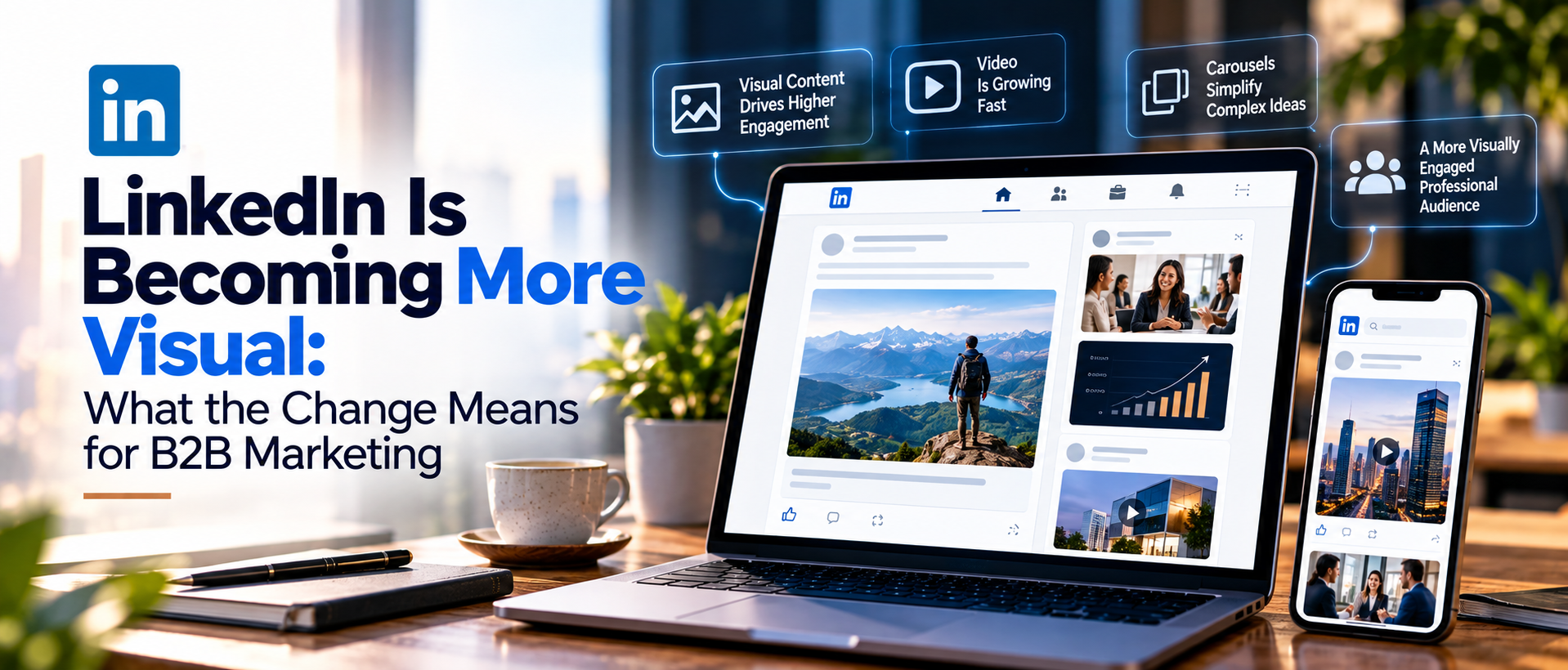
That formula still has a place, but the platform is becoming more visual. Video, document carousels, infographics, employee stories, and behind-the-scenes content are giving businesses new ways to communicate with professional audiences.
The shift is particularly relevant for B2B companies, where buying decisions often involve several stakeholders, lengthy evaluation periods, and a considerable amount of trust. A well-designed visual or a short video from a subject-matter expert can make an unfamiliar company easier to understand long before a sales conversation begins.
The opportunity isn’t to make LinkedIn look like Instagram. It’s to make professional expertise easier to see, understand, and remember.
Why Is LinkedIn Becoming More Visual?
Professional audiences are exposed to a constant stream of information. Executives, procurement teams, business owners, and technical specialists may scroll through LinkedIn between meetings, during commutes, or while catching up on industry developments.
In that environment, a dense block of text can be difficult to process quickly. Visual content offers another way to communicate an idea, demonstrate a product, or make a complicated subject more accessible.
LinkedIn’s own marketing research reflects this change. Its 2025 reporting highlighted the growth of video consumption on the platform, including a 36% year-over-year increase in video viewing. By March 2026, LinkedIn was also announcing expanded opportunities for B2B brands to work with professional creators and use video to reach decision-makers.
These developments point to a broader change in how companies can approach professional communication. Rather than relying exclusively on written posts, businesses have more opportunities to combine useful information with visual storytelling and credible human voices.
Several factors are contributing to the shift.
Video Makes Complex Ideas Easier to Understand
B2B products and services are not always easy to explain in a few sentences. Enterprise software, cybersecurity solutions, manufacturing technologies, and consulting services can involve unfamiliar terminology or complicated processes.
Video allows companies to demonstrate how something works rather than relying entirely on written explanations. A software provider can show a dashboard in action, while a manufacturing business can demonstrate an automated production process.
The advantage is practical. Buyers can see the product, hear the explanation, and begin to understand its value before arranging a demonstration or speaking with a salesperson.
Buyers Want to Understand the People Behind a Business
B2B purchasing decisions are not made by logos alone. Buyers want to know whether a company understands their challenges, whether its people have relevant experience, and whether the business can deliver what it promises.
Visual content can help answer those questions. An engineer explaining a technical challenge, a founder discussing a business decision, or a project team showing how it solved a customer problem gives audiences a more tangible sense of the people behind the brand.
This is especially important in industries where trust, expertise, and long-term relationships influence purchasing decisions.
Visual Content Can Improve Recall
A useful post should do more than attract attention for a few seconds. It should communicate an idea clearly enough that people remember it when a relevant problem arises.
Visual storytelling can help by connecting information with demonstrations, examples, people, and situations. A chart explaining an industry trend, for instance, may be easier to recall than a paragraph containing the same figures without a clear visual structure.
That does not mean every visual performs better than every written post. The message, presentation, relevance, and quality of the content all matter.
Which Visual Formats Work Best on LinkedIn?
Different formats serve different purposes. B2B marketers should choose the format that best communicates the idea rather than defaulting to video simply because it is receiving attention.
1. Short-Form Video
Short videos can introduce an idea quickly, demonstrate a product feature, answer a common question, or share an expert’s perspective.
For example, a digital marketing agency could explain one common website mistake in under a minute. A cybersecurity consultant might outline a simple security practice, while an apparel manufacturer could show how a quality-control process works on the factory floor.
The strongest videos have a clear purpose from the opening seconds. They don’t need elaborate production, but they do need a worthwhile message, understandable audio, and a presentation suited to the intended audience.
Subtitles are also useful because some viewers watch without sound. Keep the explanation focused, and give people a reason to explore the subject further if it requires more detail.
2. Document Carousels and Multi-Slide Posts
Carousels are particularly useful when an idea needs to be explained in stages. They can turn a complex subject into a sequence of manageable points without forcing the audience to read a lengthy article immediately.
A B2B software company might publish a carousel showing five steps in a process improvement project. A consulting firm could explain the stages of a digital transformation initiative, while a manufacturing company could outline the journey from product development to production.
Each slide should contribute something useful. Start with a clear promise, organise the information logically, and finish with a practical takeaway or relevant next step.
Carousels are not simply decorative slides placed inside a social post. Their value comes from helping the audience follow an argument or understand a process.
3. Infographics and Data Visualisation
B2B audiences often need to interpret research, benchmarks, performance metrics, and industry developments. Well-designed charts and infographics can make these insights easier to understand.
For example, a supply-chain consultancy might present a visual comparison of inventory strategies. A technology company could explain how a system architecture works, while an analytics firm could turn a research finding into a clear chart with a concise explanation.
Credibility is essential. Label charts accurately, provide sources for external data, and avoid manipulating scales or removing context to make a result appear more impressive than it is.
A visual should clarify the evidence, not replace it.
4. Employee Stories and Behind-the-Scenes Content
Company culture can be difficult to communicate through formal announcements alone. Employee stories, workplace footage, product-development updates, and project discussions offer a more direct view of how a business operates.
A manufacturer might introduce the specialists responsible for product quality. A software company could show how its team approaches a customer challenge, while a professional services firm might share lessons from a recent project.
These posts can make a company feel more approachable while demonstrating its expertise. They are particularly effective when employees contribute genuine knowledge rather than simply repeating corporate messaging.
Privacy, customer confidentiality, and internal approval requirements should be considered before publishing workplace or project footage.
5. Expert-Led Content and Thought Leadership
Visual content doesn’t have to be entertaining to be effective. A short explanation from a credible expert can be more valuable than a highly polished video with little substance.
B2B companies can feature engineers, consultants, product leaders, researchers, and executives discussing issues that matter to their audiences. These contributions can address common misconceptions, explain emerging developments, or offer a clear position on an industry challenge.
LinkedIn’s 2026 B2B marketing research places particular emphasis on trusted voices and creator partnerships. Its March 2026 announcement reported that 81% of surveyed B2B chief marketing officers believed video accelerated sales cycles compared with other formats. These are survey findings rather than a guarantee that video will shorten every company’s sales cycle, but they illustrate the growing interest in video as part of B2B marketing.
The central principle is straightforward: people need a reason to trust the person delivering the message, and the message itself needs to be worth their attention.
What This Change Means for B2B Marketing
The growing importance of visual content affects more than the appearance of a LinkedIn feed. It changes how businesses can communicate at different stages of the buying journey.
Brand Awareness: Help People Recognise You
At the awareness stage, potential customers may not know your business exists. They might not even have identified the exact problem your product or service solves.
Visual posts can introduce the company through useful explanations, industry observations, demonstrations, and recognisable examples of customer challenges.
A logistics technology provider, for example, could publish a short video explaining why shipment visibility matters. A viewer who encounters the content may not be ready to buy, but the company has introduced its expertise in a relevant context.
The objective is not necessarily to generate an immediate enquiry. It is to make the business easier to recognise when a need develops.
Consideration: Show How You Solve Problems
When potential customers begin comparing solutions, they need more than general claims about quality or innovation. They need evidence that a company understands their situation.
Product walkthroughs, process diagrams, expert interviews, and customer case studies can help answer those questions. A software provider could demonstrate a specific workflow, while a manufacturing business might explain how its quality-management process addresses a common production challenge.
Visual content is especially useful here because it can show the practical details behind a promise.
Where customer examples are used, ensure that performance claims are accurate, relevant permissions have been obtained, and the context is clear.
Conversion: Reduce Uncertainty Before a Purchase
As a buying decision approaches, customers may have questions about implementation, integration, reliability, support, cost, or expected results.
Content that addresses these concerns can help sales teams move conversations forward. A short technical explanation, a recorded product demonstration, or a customer case study can provide information that prospects can revisit and share with colleagues.
This is important in B2B environments where several people may influence a purchase. One stakeholder might understand the technical benefits, while another needs to evaluate costs or operational risks.
The goal is to make the decision easier to evaluate, not to replace the detailed discussions required for a complex purchase.
Why B2B Brands Should Not Abandon Text-Based Content
The move towards visual communication does not make written content irrelevant. In fact, text remains essential when audiences need depth, context, detailed analysis, or information they can refer to later.
A LinkedIn post can explain a point of view in a few paragraphs. A long-form article can examine an industry issue in detail. A document carousel can summarise the key points, while a video can introduce the topic and give it a human voice.
These formats can work together rather than compete.
Consider a company publishing research about manufacturing efficiency. It could share the main finding in a concise LinkedIn post, present the data in a visual chart, record an expert explaining the implications, and publish the full analysis on its website.
Each format serves a different audience need, and the same core research supports the entire content programme.
This approach also creates more value from the work involved in developing original insights. Instead of treating every social post as an isolated task, marketers can build a connected collection of content around subjects their audiences care about.
How to Build a Visual LinkedIn Strategy
B2B marketers do not need to overhaul their entire content strategy overnight. A measured approach makes it easier to identify what works and build a repeatable process.
Start With Audience Questions
Identify the questions customers ask during sales conversations, product demonstrations, onboarding sessions, and customer-support interactions.
These questions often provide better content ideas than generic brainstorming. If prospects repeatedly ask how a product integrates with existing systems, that could become a short demonstration, a carousel explaining the process, or an expert-led video.
The objective is to answer real questions, not simply produce content to maintain a posting schedule.
Match the Format to the Message
Some ideas are best explained visually. Others need written analysis or a combination of formats.
Use video when seeing a process or hearing an expert adds value. Use carousels when information benefits from a step-by-step structure. Use charts when data needs to be compared. Use text when a nuanced argument requires space.
A format should make the message clearer, not make the production process more complicated.
Make Content Feel Human
Professional does not have to mean impersonal. A clear explanation delivered by a knowledgeable employee can be more engaging than a corporate script filled with abstract claims.
Encourage employees to speak naturally, use examples from their experience, and explain concepts in language customers understand. Visual consistency is useful, but every video does not need studio lighting, elaborate graphics, or a scripted presentation.
Authenticity should not be confused with carelessness. The content still needs to be accurate, well organised, and appropriate for a professional audience.
Build a Sustainable Publishing Process
Creating video and visual content can require more planning than writing a short text update. Businesses should establish a manageable process for choosing topics, recording material, reviewing claims, approving content, and publishing across channels.
Batching production can help. A single expert interview might provide several short clips, a written article, a set of carousel slides, and answers to common customer questions.
Repurpose the underlying insight rather than blindly duplicating the same content everywhere. A LinkedIn video may need a different introduction and structure from the longer article that supports it.
Measure Business Outcomes, Not Just Engagement
Likes and views can help indicate whether content is attracting attention, but they do not tell the whole story.
Track performance against the purpose of each post. Useful measures may include:
- Awareness: Reach, impressions, video views, and relevant audience growth.
- Engagement: Comments, shares, saves, and substantive conversations.
- Consideration: Website visits, resource downloads, event registrations, and return visits.
- Conversion: Qualified enquiries, demo requests, opportunities influenced, and eventual revenue where attribution is available.
For B2B businesses, the impact may emerge over weeks or months rather than immediately after publication. Use tracking links, campaign reporting, and feedback from sales teams to understand whether content is helping prospects move through the buying process.
Avoid attributing every lead to the last LinkedIn post someone saw. Complex purchases often involve multiple interactions across different channels.
Common Mistakes to Avoid
A visual-first approach can fail when businesses focus on appearance without improving the substance of their communication.
Making everything look like an advertisement can weaken credibility. Professional audiences are often looking for useful insights, practical explanations, and evidence that a business understands their challenges.
Overproducing every video can waste resources. Good lighting and clear audio matter, but expensive production is not necessary for every expert explanation or product demonstration.
Following trends without considering the audience can make a company appear disconnected from its industry. A format that works for a consumer entertainment account may not suit a specialist B2B service.
Publishing visuals without context can leave viewers unsure why the information matters. A chart needs an explanation, a demonstration needs a clear point, and a customer story needs to communicate a meaningful lesson.
Ignoring accessibility can exclude people from the content. Use readable text, strong contrast, descriptive captions, and subtitles where appropriate. Avoid putting essential information only in tiny graphics or relying entirely on sound.
Most importantly, do not assume that visual content is automatically effective. A useful written post can outperform a poorly conceived video, just as a strong demonstration can explain a product better than several paragraphs of marketing copy.
The Future of Visual B2B Marketing on LinkedIn
LinkedIn’s direction suggests that visual communication, video, and trusted professional voices will remain important parts of its B2B marketing environment. As more companies experiment with these formats, simply publishing a video will not be enough to stand out.
The stronger opportunity lies in making expertise visible. Businesses that can explain difficult concepts clearly, show how their solutions work, and give credible people a platform to share their knowledge will have more ways to earn attention and build confidence.
That doesn’t require abandoning the principles that have always made good B2B marketing effective. Relevance, credibility, consistency, and a clear understanding of the customer still matter. Visual formats simply offer additional ways to put those principles into practice.
For marketers, the next step is not to make every LinkedIn post more colourful or turn every employee into a content creator. It is to identify where a demonstration, diagram, photograph, or human explanation would communicate an idea better than text alone.
LinkedIn is becoming more visual, but substance remains the advantage. The brands that stand out will be those that give their audiences something genuinely useful to see, understand, and remember.