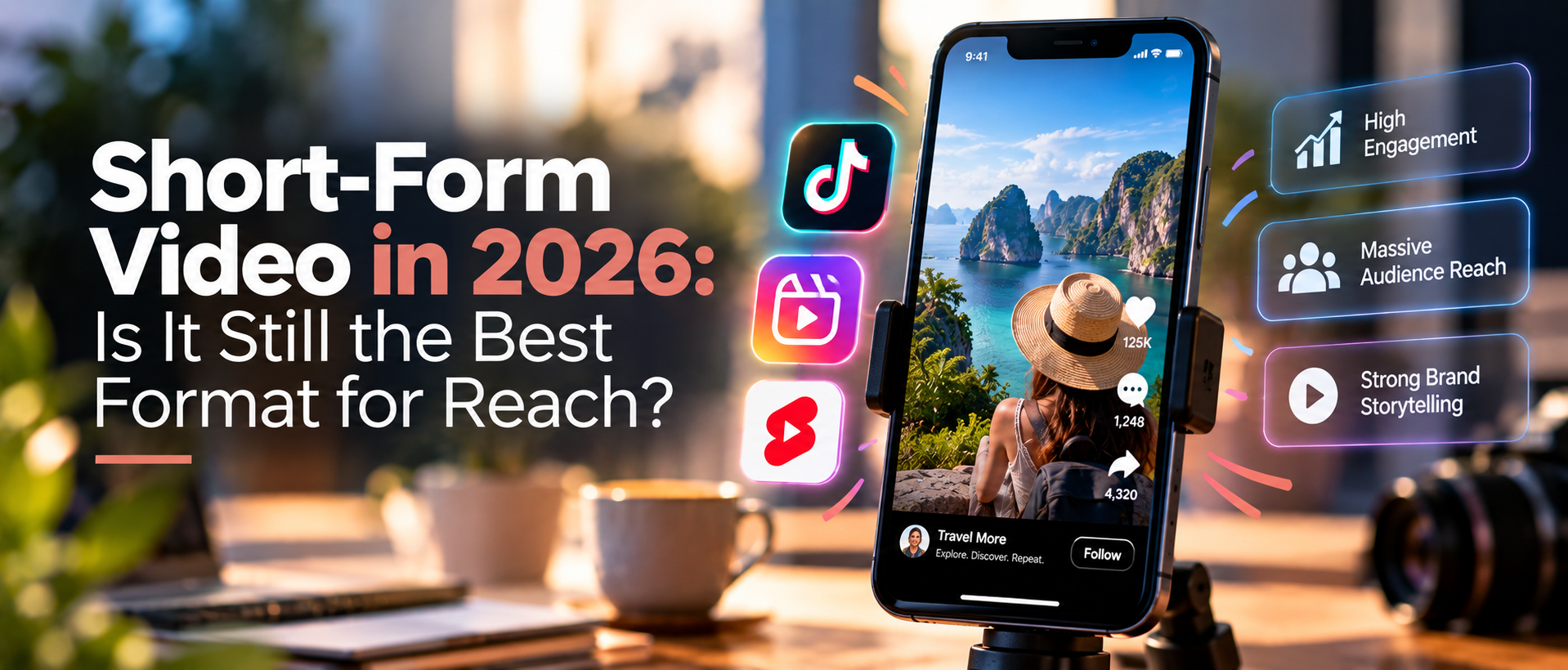

Short-form video isn’t dead. But the days when a business could post a few Reels, jump on a trending sound, and expect thousands of views may be becoming less predictable.
In 2026, short-form video remains a major part of digital marketing. TikTok, Instagram Reels, and YouTube Shorts continue to compete for viewers’ attention, while platforms invest in video discovery and recommendation systems. YouTube, for example, reported that Shorts averaged 200 billion daily views in its 2026 business update.
Yet there’s a difference between getting views and building an audience that cares about a brand. A video can reach thousands of people without generating meaningful engagement, website visits, enquiries, or sales. For businesses, that distinction matters more than ever.
The real question isn’t whether short-form video still works. It’s whether it’s the right format for your audience, your objectives, and the kind of relationship you want to build with potential customers.
Why Short-Form Video Still Matters in 2026
Short-form video fits naturally into the way people consume content on social media. A viewer can discover a new brand, learn something useful, watch a product demonstration, or hear an expert’s opinion without committing to a lengthy video.
That convenience makes it particularly useful for introducing ideas and capturing attention.
A skincare brand can demonstrate how a product feels on the skin. A travel company can show a destination in a few seconds. A software business can explain a useful feature through a quick screen recording. Each example gives viewers a reason to stop scrolling and pay attention.
Short videos can also reach people who have never interacted with a brand before. Recommendation feeds expose content to users based on their interests and viewing behaviour, rather than relying exclusively on an existing follower base.
YouTube explains this in its official Shorts search and discovery guidance. Its recommendation systems consider signals such as whether people choose to watch a video, how long they stay, and whether they appear to enjoy the experience.
This means a smaller account can still find an audience when its content resonates with the right viewers. A large following alone doesn’t guarantee that every new post will receive extensive distribution.
Which Platform Offers the Best Reach?
There isn’t one universal winner. TikTok, Instagram Reels, and YouTube Shorts have overlapping audiences, but each platform serves different viewing habits and marketing objectives.
TikTok: Discovery and Entertainment
TikTok remains a strong option for brands that can turn an idea into entertaining, relatable, or useful content. Its recommendation-driven experience allows videos to reach viewers beyond an account’s existing followers.
The platform is particularly suitable for demonstrations, storytelling, reactions with original commentary, niche communities, and content that feels natural rather than overly polished.
A travel brand, for example, might share a short video showing the difference between a popular tourist attraction and a lesser-known alternative. A technology company might explain a common digital problem in a direct, conversational way.
The challenge is competition. A video needs a compelling reason to hold someone’s attention, and copying a popular format without adding anything distinctive rarely creates a lasting advantage.
Instagram Reels: Discovery and Brand Interaction
Instagram Reels can help brands reach new audiences while connecting short videos to their wider presence on the platform. Viewers can move from a Reel to a profile, explore other posts, browse products, or send a direct message.
That makes Instagram useful for businesses where visual identity, community, and ongoing customer relationships matter.
Fashion, travel, beauty, food, fitness, and lifestyle brands can use Reels to show products in context rather than relying entirely on static promotional images. Service businesses can also use short videos to explain their expertise, answer common questions, and introduce the people behind the company.
Originality matters here, too. Meta has stated that it is prioritising original content in Facebook Feed and Reels while reducing distribution for unoriginal or minimally altered reposts. Its March 2026 creator update reinforces a broader platform emphasis on content that contributes something meaningful.
YouTube Shorts: Discovery With Longer-Term Potential
YouTube Shorts offers a useful bridge between quick discovery and a broader content library. Someone who finds a creator through a short video can continue watching longer videos, explore related topics, or subscribe for future content.
This can be particularly valuable for educational brands, software companies, consultants, product reviewers, and businesses that benefit from explaining complex subjects.
Consider a digital marketing agency that publishes a 30-second video explaining one common SEO mistake. The viewer might then watch a longer tutorial, read a detailed guide, or visit the agency’s website to learn more.
YouTube is also expanding how creators organise short-form content. In September 2026, the company announced Shorts series features that allow eligible creators to structure videos into seasons and episodes, supporting more connected storytelling rather than isolated clips.
The opportunity is not simply to make every video shorter. It is to create a clear path from an initial moment of interest to deeper engagement.
Is Short-Form Video Actually Delivering Better Reach?
The answer depends on what is being measured.
A useful indication comes from Metricool’s 2026 short-form video research, published in August. Its analysis covered more than six million videos from over 375,000 accounts across TikTok, Instagram, and YouTube.
The report found that TikTok led in average views per video, Instagram performed strongly in interactions, and YouTube Shorts produced lower average reach in the dataset. It also noted that results varied according to account size.
These findings are useful, but they should not be treated as a universal ranking. The performance of an entertainment creator, a small local business, and a specialist B2B company can differ substantially. Industry, audience location, content quality, posting history, and the type of video all influence results.
More importantly, average reach is not the same as business value.
A video that reaches 50,000 people but generates no relevant enquiries may be less valuable than one that reaches 3,000 highly interested viewers and brings in several qualified leads. The right benchmark depends on what the business needs to achieve.
For marketers, this means evaluating platform performance against specific objectives rather than assuming that the largest view count automatically represents the best result.
Why Some Short Videos Fail to Gain Traction
Short-form video has become accessible to almost everyone with a smartphone. That creates opportunity, but it also means audiences face an enormous volume of competing content.
Several common mistakes make it harder for businesses to stand out.
Starting Without a Clear Hook
Viewers make quick decisions about whether a video deserves their attention. A slow introduction, lengthy logo animation, or vague opening can give people little reason to continue watching.
A stronger opening establishes the subject or benefit immediately.
Instead of beginning with, “Hello everyone, welcome to our page,” a business could start with, “Three website mistakes that cost small businesses customers.”
The goal isn’t to manufacture drama. It’s to make the value of watching clear from the beginning.
Chasing Trends Without a Strategy
Trending sounds and popular formats can help content feel relevant, but they are not a substitute for a clear message.
A trend that works for a comedy creator might feel awkward for a cybersecurity consultancy. Similarly, a dance-based format may generate attention for a product without explaining why anyone should buy it.
Before adopting a trend, ask whether it fits the brand, reaches the intended audience, and supports the message. If it doesn’t, an original idea may be a better investment.
Publishing Repetitive or Unoriginal Content
Reposting another creator’s video with minor edits might be easier than producing original material, but it offers little reason for an audience to follow the account itself.
Platforms are also placing greater emphasis on originality. Businesses should focus on their own demonstrations, opinions, experiences, case studies, and explanations.
Even a simple video can be distinctive when it contains a useful insight that viewers cannot get from hundreds of similar posts.
Measuring Success by Views Alone
High view counts can create the impression that a campaign is working, even when the audience isn’t taking the next step.
A business should look beyond views to understand whether the content is attracting the right people. Saves, shares, profile visits, website clicks, enquiries, and conversions can reveal more about the quality of that attention.
Not every video needs to generate an immediate sale. Some are intended to build awareness or introduce a brand to a new audience. The important thing is to know the purpose of each piece of content and measure it accordingly.
What Types of Short-Form Videos Work Best in 2026?
There is no single formula that works across every industry. However, several content approaches give businesses practical ways to create videos that provide genuine value.
Educational videos explain a problem, answer a common question, or teach a small but useful skill. A software company might demonstrate a shortcut that saves time, while a marketing agency could explain why a website isn’t attracting enquiries.
Product demonstrations show how something works in a real situation. Rather than listing features, a brand can show the product being used, explain its practical benefits, and address a common customer concern.
Behind-the-scenes content introduces the people and processes behind a business. Manufacturing footage, product development, packaging, team discussions, and preparation for a project can make a brand feel more tangible and relatable.
Customer stories and case studies offer context that promotional claims often lack. A short video might explain a customer’s original problem, the approach taken, and the outcome achieved. Claims should be accurate and supported by evidence.
Myth-busting and opinion-led videos give audiences a clear point of view. A cybersecurity company might challenge a common misconception about password security, while a travel business could explain why the cheapest flight isn’t always the most economical option.
The strongest format is the one that communicates the message clearly and gives the audience a reason to care. Length, editing style, and production quality should support that purpose rather than become the purpose themselves.
Short-Form Video vs Other Content Formats
Short-form video is powerful, but it isn’t automatically the best choice for every marketing objective. Static posts, carousels, articles, email newsletters, podcasts, and longer videos each have strengths that short clips cannot fully replace.
| Content format | Best suited for | Main limitation |
| Short-form video | Discovery, demonstrations, quick explanations, brand awareness | Limited space for complex topics |
| Carousels and static posts | Step-by-step information, visual summaries, quick reference | May generate less immersive storytelling |
| Long-form video | Tutorials, detailed explanations, product reviews, demonstrations | Requires more time and attention |
| Blog articles | Search visibility, in-depth information, detailed answers | Usually takes longer to produce and consume |
| Email newsletters | Retention, direct communication, repeat engagement | Requires an audience willing to subscribe |
| Podcasts | Extended discussions, expert perspectives, relationship-building | Less suitable for audiences seeking immediate visual answers |
Imagine a company introducing a new software service. A 20-second video could capture attention by showing a useful feature. A carousel could explain the steps involved. A detailed article could answer technical questions, while an email could guide interested prospects towards a demonstration.
Each format plays a different role. Together, they can create a more complete customer journey than any single piece of content.
How Businesses Should Approach Short-Form Video in 2026
The smartest approach is to treat short-form video as part of a broader content strategy, not as an obligation to post videos every day.
Start with the audience. Identify the questions customers ask, the problems they want solved, the products they are considering, and the information they need before making a decision. These are natural starting points for video ideas.
Next, match the content to the objective. A video intended to reach new audiences may need a different opening from one designed to explain a product to existing followers. A brand-awareness video should not be judged by the same criteria as a lead-generation campaign.
Then, test a small number of formats consistently. Try short tutorials, demonstrations, customer questions, and original commentary. Review the results after enough posts have been published to identify meaningful patterns.
Pay attention to audience retention, shares, saves, profile visits, website traffic, and conversions. Where possible, use tracking links and campaign analytics to connect content performance to actual business outcomes.
Finally, reuse strong ideas intelligently. A short video can become the starting point for a blog article, an email, a carousel, or a longer tutorial. Adapt the message to each format instead of uploading the same asset everywhere without considering how people use each platform.
Consistency helps, but it should not come at the expense of quality or the wellbeing of the people producing the content. A sustainable publishing schedule is more useful than an ambitious schedule that cannot be maintained.
The Role of AI in Short-Form Video Creation
Artificial intelligence is making parts of video production more accessible. Tools can assist with captioning, transcription, editing, idea development, script preparation, and adapting existing footage into different formats.
For small businesses, these capabilities can reduce the time required to produce and distribute content. A single recorded interview, for example, might provide material for several short clips, a longer video, and an article.
However, faster production doesn’t automatically produce better content. If every brand uses similar AI-generated scripts, stock footage, and predictable hooks, audiences may struggle to distinguish one account from another.
Human judgement remains important. The strongest content reflects a real understanding of the audience, a specific point of view, and details that make the business distinctive. AI can support the production process, but it cannot replace the need for a worthwhile message.
Businesses should also review generated captions, factual claims, permissions, and platform requirements before publishing. Efficiency matters, but accuracy and trust matter more.
So, Is Short-Form Video Still the Best Format for Reach?
For many businesses, short-form video remains one of the strongest options for introducing a brand to new audiences. It is accessible, adaptable, and well suited to recommendation-driven platforms where people discover content beyond the accounts they already follow.
But calling it the best format in every situation misses the point.
A video can attract attention, while an article provides the detail someone needs to make a decision. An email can bring a customer back, and a longer tutorial can build confidence in a product. Marketing works best when these formats support one another.
The businesses most likely to benefit from short-form video are those that understand what their audiences want, publish original material, and connect attention to a clear purpose. They don’t chase views simply because views are easy to count.
In 2026, reach still matters. But reaching the right people, giving them a reason to care, and helping them take the next step matters far more.