
Someone looking for a restaurant no longer has to start with Google.
They might open TikTok, search for the best places to eat nearby, watch three videos, read the comments and save one of the recommendations. Someone researching a skincare product might do the same thing on Instagram. A traveller looking for a hotel may search YouTube for room tours. A B2B buyer might turn to LinkedIn to see what people in the industry are actually saying.
The search box has moved.
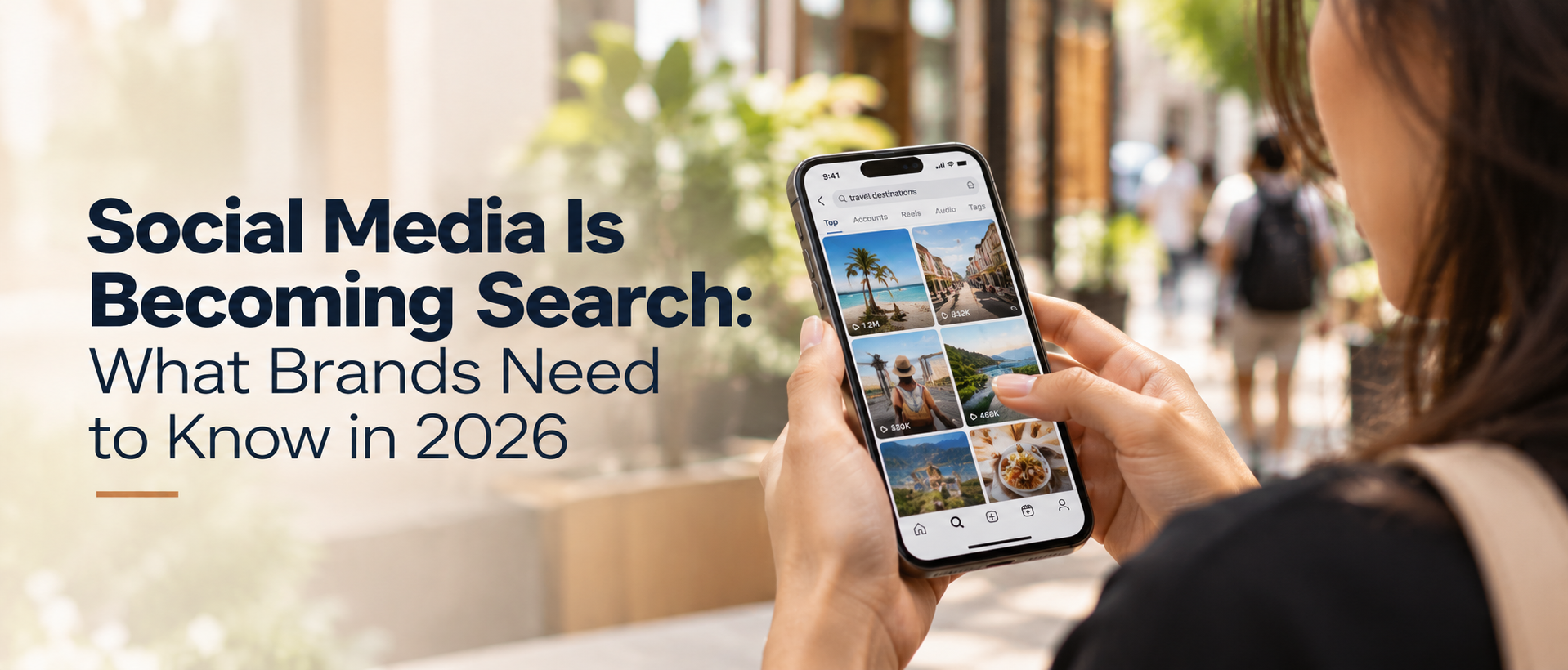
Social media is no longer just where people discover content after someone sends it to them. Increasingly, it is where people actively look for information, recommendations, products, reviews and answers.
That does not mean Google has stopped mattering. It means brands are now competing for visibility across several search environments, each with its own behaviour, language and signals.
For marketers, this changes the question from:
“How do we get more people to see our social content?”
to:
“What happens when someone searches for the thing our brand sells?”
Social search is no longer a niche behaviour
The shift is already measurable.
Sprout Social’s Q2 2025 research found that 37% of consumers overall use social media as their starting point for product research, rising to 41% among Gen Z. Its research also found that 76% of consumers had purchased something in the previous six months because of content they saw on social media.
The behaviour is particularly visible on platforms such as TikTok, Instagram and YouTube, where search results are mixed with video, creator recommendations, comments and community discussion.
TikTok itself describes 2026 as a period of deeper discovery, with users increasingly arriving with an intention and then following unexpected paths through related content.
That is an important distinction.
Traditional search often begins with a question.
Social search can begin with curiosity.
Someone might search:
“Best running shoes for beginners”
But after watching one video, they might search for a specific shoe, look at reviews, check how it fits, find another creator comparing it with a competitor and then read the comments.
The search journey becomes much more fluid.
Why people search differently on social platforms
Google is designed primarily to retrieve information.
Social platforms combine information with people.
That changes the experience.
When someone searches TikTok for a destination, they can see the destination rather than simply read about it. When they search Instagram for a restaurant, they can see the food, atmosphere and customer posts. When they search YouTube for a product, they can watch someone actually use it.
The result is a different kind of search behaviour.
| Traditional search | Social search |
| Text-heavy results | Video, images and creator content |
| Websites dominate | Creators, brands and communities all contribute |
| Often starts with a specific question | Can start with curiosity or inspiration |
| Strong emphasis on relevance and authority | Relevance, engagement, personality and experience matter |
| User usually leaves the search engine | Discovery can continue inside the platform |
| Often informational | Frequently mixes information, entertainment and commerce |
Neither model is replacing the other completely.
They are increasingly overlapping.
Google itself has acknowledged that modern search behaviour is becoming more conversational and complex as AI changes how people research products and information.
Social search is part of that broader change in discovery.
TikTok is a good example of where search is heading
TikTok is particularly interesting because search and recommendation are deeply connected.
A person can arrive without knowing exactly what they want, encounter a video, become interested in something and then search for more information about it.
TikTok’s own research describes three overlapping discovery behaviours:
- Swipe to Discover: finding something through the For You feed
- Tap to Discover: exploring through profiles, comments, hashtags and related content
- Search to Discover: actively searching for information after seeing something or starting with a specific need
That makes social search different from simply optimising a caption for keywords.
A piece of content needs to be useful enough to appear in a search journey and interesting enough to continue that journey.
Instagram is becoming part search engine, part recommendation engine
Instagram has a similar dynamic.
People search for restaurants, destinations, outfits, beauty products, recipes, creators and brands. They also use the platform to validate things they have already discovered elsewhere.
This is important because social search is not always the first step.
Someone might discover a product on TikTok, search the brand on Instagram, check its profile and then Google the product before purchasing.
The journey crosses platforms.
Recent BrightEdge research illustrates just how much social content is also entering Google’s AI-generated answers. Its analysis of approximately 300 million monthly searches found Facebook appearing as a source in 19.5 million AI Overviews and Instagram in 877,000. The research also found that different social platforms tend to contribute different types of information, with Instagram appearing particularly around areas such as culture, entertainment, food, travel and shopping.
That has a major implication for brands:
Your social content may influence people who never see your original post.
It can potentially become part of the information ecosystem that search engines and AI systems use to understand a topic.
Search optimisation now has a social layer
For years, SEO teams focused heavily on things such as:
- Search intent
- Keywords
- Page structure
- Backlinks
- Technical SEO
- Internal linking
- Content quality
Those fundamentals still matter.
But social search adds another layer.
Brands need to think about the words people actually use when searching within each platform.
For example, a skincare brand might optimise a website around:
best moisturiser for dry skin
But its TikTok content might need to address natural variations such as:
- Best moisturiser for very dry skin
- Moisturiser for dry skin under makeup
- Why does my moisturiser pill?
- Best moisturiser for sensitive skin
- Drugstore moisturiser that actually works
The language is more conversational.
The content is also expected to provide an answer quickly.
Your captions are becoming searchable content
This is one of the simplest changes marketers can make.
A caption should not exist only to accompany a video.
It can help explain what the content is about.
Instead of writing:
“You asked. We delivered 👀”
a brand selling travel bags could write:
“Looking for a carry-on backpack that fits under most airline seats? Here are three features to check before you buy.”
The second version gives the platform more contextual information and, more importantly, gives the audience a reason to keep reading.
The same principle applies to spoken content.
If a video is about choosing a running shoe, actually saying the subject of the video matters.
Write for people first, but make the subject unmistakably clear.
Comments are becoming part of the content
One of the more interesting developments in social search is the role of comments.
People do not always stop after watching the original video.
They look at:
- Questions from other users
- Brand responses
- Personal experiences
- Complaints
- Recommendations
- Corrections
- Product comparisons
TikTok’s 2026 trend research explicitly encourages brands to treat comments, reactions, memes and community participation as part of the creative surface rather than as something that happens after the content has been published.
This creates an opportunity.
A brand can publish a useful piece of content, identify recurring questions in the comments and then turn those questions into the next pieces of content.
The result is a content system rather than a sequence of disconnected posts.
Stop thinking only about keywords
Social search is not traditional SEO copied onto Instagram or TikTok.
A keyword alone does not make a piece of social content useful.
Think about the question behind the search.
Someone searching:
“best laptop for graphic design”
may actually be trying to answer:
- Is 16GB RAM enough?
- Which screen is better for colour accuracy?
- Does this model overheat?
- Can it handle Adobe software?
- Is it worth paying more for the higher specification?
- What happens after the warranty expires?
Those questions are content opportunities.
The brands that understand the underlying decision are more useful than brands that simply repeat the keyword.
Product discovery is becoming more visual
This is particularly important for consumer brands.
People can now discover products through video demonstrations, styling content, unboxings, reviews, comparisons and creator recommendations.
Google’s current search direction reflects the same broader movement toward visual and multimodal discovery. Google reports that one in five Google Lens searches has commercial intent, meaning visual discovery can increasingly lead directly toward product research.
For brands, that means product content should answer questions visually.
Show:
- What the product looks like in real life
- Its size
- How it works
- How it compares
- How it fits
- How it sounds
- How it performs
- What comes in the box
- Who it is actually suitable for
A polished product photograph can communicate appearance.
A useful video can communicate experience.
Follower count is not the whole story
The old social-media mindset was heavily focused on audience size.
How many followers do we have?
How many people saw the post?
How many likes did it get?
Those numbers still matter, but discovery-driven social platforms make another question increasingly important:
Can the right person find this content when they need it?
A small creator who publishes an excellent answer to a very specific question may be more useful to a searcher than a large account posting generic content.
That also creates opportunities for smaller brands.
You do not necessarily need millions of followers to become discoverable.
You need content that answers questions people actually ask.
Social search and Google search should work together
There is no reason to choose between SEO and social search.
In fact, the two can strengthen each other.
A company might publish a detailed article answering a customer question. That article can become:
- A short TikTok explanation
- An Instagram carousel
- A YouTube video
- A LinkedIn post
- A Reddit discussion where appropriate
- A customer FAQ
- A product comparison
- A creator briefing
Each format reaches people in a different discovery environment.
The underlying information remains connected.
This is particularly important as AI search grows.
Google’s own research shows that consumers continue to move between social platforms and traditional search when researching products. Google reports that 70% of social media users use Google Search to evaluate products they discovered on social media.
Discovery can therefore look like:
TikTok → Google → YouTube → Instagram → brand website → purchase
rather than:
Google → website → purchase
The old linear funnel is becoming much harder to describe.
What brands should change in 2026
Brands do not need to turn every social post into an SEO article.
They do need to become more deliberate about discoverability.
1. Build content around real questions
Look at customer service queries, comments, reviews, sales conversations and search data.
Find the questions people repeatedly ask.
Then answer them.
2. Say what the content is about
Do not hide the subject behind a vague copy.
If the video explains how to choose a carry-on suitcase, say that.
If it compares two phones, name both phones.
If it demonstrates a skincare routine, explain the routine.
Clarity helps both people and search systems understand the content.
3. Use natural search language
People do not always search the way marketers write.
Use conversational phrasing where appropriate.
Think:
“What shoes should I wear for 10K?”
rather than forcing:
“Best 10K running shoes 2026”
into every sentence.
4. Turn comments into your content calendar
Questions that appear repeatedly are telling you something.
If five people ask the same question, you may already have your next video.
5. Make content worth saving
Search is only part of social discovery.
People save useful content for later.
Checklists, comparisons, tutorials, destination guides, product explanations and practical tips can all have a longer useful life than purely promotional posts.
6. Think beyond your own account
Your brand is not the only source of information about your brand.
Creators, customers, reviewers, communities and publications all contribute to what people find.
That means reputation and third-party visibility increasingly matter alongside owned content.
What should brands measure?
Follower growth alone tells only part of the story.
A search-oriented social strategy should consider metrics such as:
- Searches or search impressions where the platform provides them
- Views from search or discovery surfaces
- Saves
- Shares
- Profile visits
- Product-page visits
- Branded searches
- Comments containing purchase questions
- Traffic from social platforms
- Conversions influenced by social content
- Mentions by creators and customers
The exact metrics vary by platform, so brands should avoid creating one universal social-search score.
The more useful question is whether discoverability is creating meaningful downstream behaviour.
The biggest mistake: making everything sound like SEO
There is a danger in all of this.
Once marketers realise that social platforms are becoming search engines, the temptation is to fill captions with keywords.
That can make content sound unnatural.
It can also destroy the very quality that makes social search valuable in the first place.
People are not searching social platforms because they want another page of corporate copy.
They are looking for people, demonstrations, opinions, experiences and useful answers.
TikTok’s 2026 research reflects this shift, highlighting demand for honesty, community, real processes and human imperfection rather than overly polished brand communication.
The answer is not to make social content more robotic.
It is to make it more useful and more discoverable at the same time.
Social media is becoming part of the search journey
The important change in 2026 is not that Google has disappeared or that every consumer now searches TikTok instead.
The change is that search has fragmented.
People search where they expect the best answer to live.
They search Google for broad information and comparison. They search YouTube when they want to see something explained. They search TikTok for discovery, trends and quick experiences. They search Instagram for visual inspiration, products, places and people. They turn to communities when they want firsthand experiences.
AI is adding another layer by pulling information from websites, social platforms and other sources to construct answers.
For brands, this means visibility can no longer be treated as a single ranking position.
Your website matters.
Your social content matters.
Your creators matter.
Your customers’ experiences matter.
And increasingly, the connections between all of them matter too.
The brands that adapt will not simply create content people can scroll past.
They will create content that can be found when someone is looking for an answer.
That is the real shift from social media as a publishing channel to social media as part of the search infrastructure.