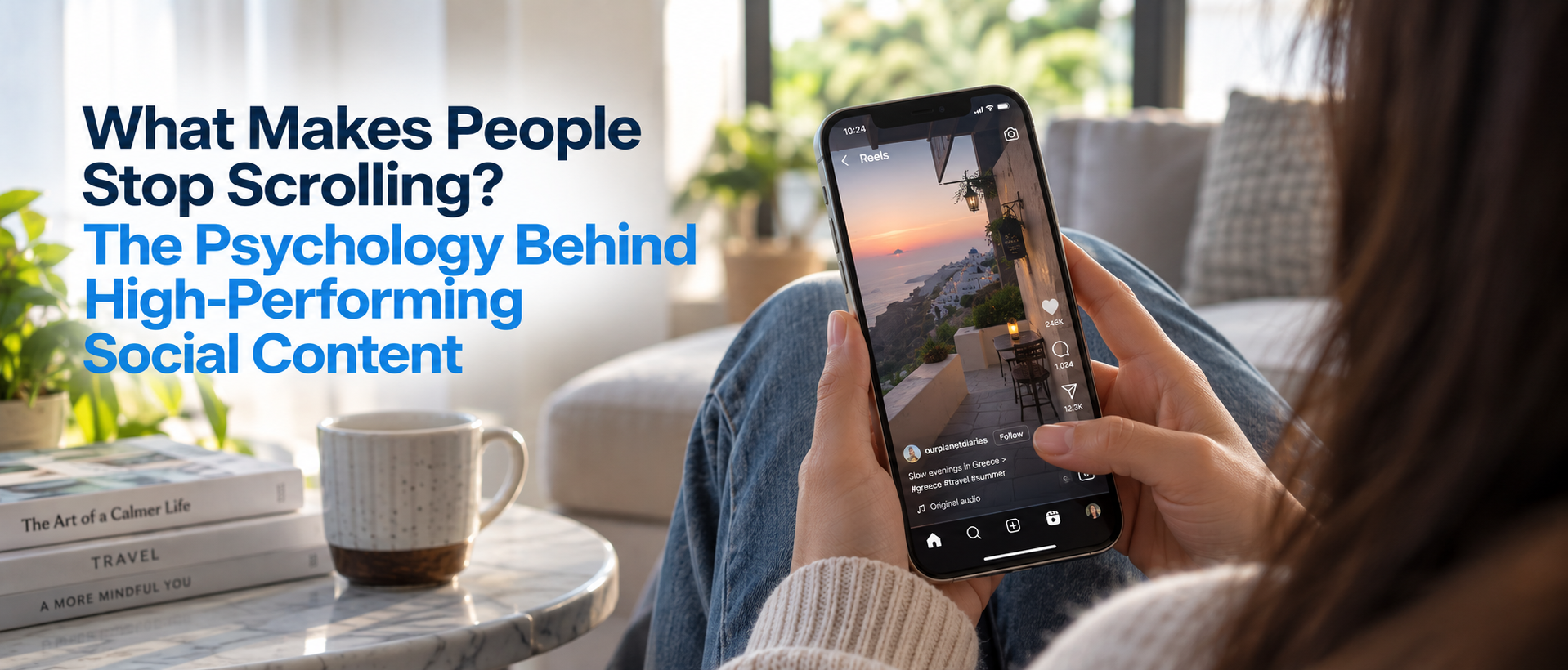

People scroll through social media quickly. In a feed filled with videos, images, advertisements, memes, news and creator content, brands often have only a few seconds to earn someone’s attention.
That makes one question particularly important for marketers:
What actually makes someone stop scrolling?
The answer is not simply better design, bigger text or a more expensive video.
High-performing social content often works because it triggers a psychological response. It creates curiosity, recognition, emotion, surprise or relevance quickly enough to interrupt the user’s scrolling behaviour.
Understanding these psychological principles can help brands create content that people notice, remember and engage with instead of simply passing by.
Why People Scroll in the First Place
Social media scrolling is often habitual.
Users are not necessarily entering a platform with the intention of carefully evaluating every piece of content. They are browsing, looking for entertainment, information, connection or something interesting enough to capture their attention.
This creates a challenging environment for brands.
The user’s brain is constantly making rapid decisions:
Interesting or boring?
Relevant or irrelevant?
New or familiar?
Worth watching or worth skipping?
Content that immediately provides a reason to continue has a better chance of breaking through that decision process.
1. Curiosity Creates an Information Gap
One of the strongest psychological mechanisms behind effective social content is curiosity.
People become interested when they know enough about something to recognize that information is missing.
For example:
“We made one small change to our website and conversions increased.”
This creates an immediate question:
What was the change?
Compare that with:
“Here are five ways to improve your website conversion rate.”
The second statement communicates information, but the first creates an information gap that encourages the viewer to find out what happens next.
This is why hooks such as:
- “Nobody tells you this about…”
- “We tested this for 30 days…”
- “Here’s what happened when…”
- “The mistake we kept making…”
- “You might be doing this wrong…”
can be effective when the content genuinely delivers on the promise.
Curiosity should create interest, not deception.
2. Relevance Beats Random Creativity
A visually impressive post can still fail if the audience does not immediately understand why it matters to them.
People pay more attention to information that connects with their current interests, problems or goals.
For a fitness brand, a hook such as:
“Why you’re still tired after your workout”
is immediately relevant to someone experiencing that problem.
For a B2B technology company:
“Your team may already be using AI without your IT department knowing.”
creates relevance around a problem that many businesses may recognize.
The important principle is:
Attention increases when people believe the content is about something that matters to them.
This is why understanding the audience is often more important than simply producing more content.
3. Pattern Interrupts Break the Scrolling Rhythm
Social feeds are repetitive by nature.
Users see similar layouts, colours, talking-head videos, product shots and promotional messages repeatedly.
A pattern interrupt introduces something unexpected.
It could be:
- An unusual opening visual
- A surprising statement
- A sudden change in movement
- An unexpected question
- A distinctive composition
- A different editing rhythm
- A counterintuitive fact
The purpose is not to be strange for the sake of being strange.
The purpose is to create enough novelty for the viewer to pause.
A simple opening such as:
“Stop. Don’t buy that yet.”
can create more attention than:
“Here are our latest products.”
The first disrupts the user’s expectation. The second resembles conventional advertising.
4. Emotion Gives People a Reason to Care
Information can be useful.
Emotion makes it meaningful.
Social content can trigger emotions such as:
- Surprise
- Joy
- Curiosity
- Nostalgia
- Amusement
- Inspiration
- Concern
- Excitement
- Empathy
Emotional content is not automatically successful, but emotion can make information more noticeable and memorable.
Consider two approaches to promoting a travel destination.
Functional:
“Kyoto has more than 1,600 Buddhist temples.”
Emotional:
“Imagine walking through Kyoto before the city wakes up, with temple bells echoing through nearly empty streets.”
The second approach gives the audience something to imagine.
The strongest content often combines information with an emotional reason to care.
5. Familiarity Can Be Just as Powerful as Novelty
Not every successful post needs to surprise people.
Sometimes recognition is what makes someone stop.
A viewer might see a post and think:
“That’s exactly what happens to me.”
This is particularly powerful for relatable content.
Examples include:
- Workplace experiences
- Parenting moments
- Travel frustrations
- Customer problems
- Everyday habits
- Industry inside jokes
- Common mistakes
Relatability creates a sense of personal relevance.
A simple social post saying:
“When you open your laptop to do one thing and somehow end up with 17 tabs open…”
can perform because many people recognize themselves in it.
The content does not need to teach something extraordinary.
It needs to make the audience feel seen.
6. People Naturally Notice Contrast
Contrast makes information easier to process.
This is why before-and-after content performs well across many industries.
Examples include:
Before vs after
Expectation vs reality
Old method vs new method
What people think vs what actually happens
Cheap vs expensive
Manual vs automated
Contrast creates a clear mental comparison.
For brands, this can also make complex products easier to understand.
Instead of explaining every feature of an automation platform, a video could show:
Before: 4 hours of manual work
After: 20 minutes of automated processing
The contrast communicates the value quickly.
7. Faces and Human Stories Capture Attention
People are naturally responsive to other people.
That is one reason human-centred content continues to play such an important role on social platforms.
A founder explaining a problem, an employee sharing an experience or a customer describing an outcome can make a brand feel more human.
This does not mean every post needs a person speaking directly into the camera.
It means that social content can benefit from:
- Personal experiences
- Customer stories
- Behind-the-scenes moments
- Founder perspectives
- Employee content
- Real reactions
- Interviews
- Demonstrations
People often connect with people before they connect with brands.
8. Movement Can Win the First Second
Video has an obvious advantage on platforms built around motion.
Movement can immediately signal that something is happening.
This might be:
- A product entering the frame
- A person moving toward the camera
- A rapid transition
- A transformation
- An unexpected visual change
- A demonstration beginning immediately
However, movement should support the story.
Fast editing without a clear purpose can create visual noise rather than attention.
The first seconds should answer an implicit question:
Why should I keep watching?
9. Specificity Makes Content More Credible
Vague claims are easy to ignore.
Specific information feels more concrete.
Compare:
“AI can save your business time.”
with:
“This workflow reduced a four-step reporting process from two hours to 15 minutes.”
The second statement gives the audience something tangible.
Specificity can come from:
- Numbers
- Examples
- Time periods
- Real experiences
- Named problems
- Clear outcomes
- Demonstrations
This is particularly important for B2B content, where audiences are often looking for evidence rather than entertainment alone.
10. Stories Keep People Watching
Humans naturally process information through stories.
A simple structure can turn an ordinary piece of information into something worth following.
One effective framework is:
Problem → Tension → Discovery → Outcome
For example:
Problem:
“Our website traffic was growing, but sales weren’t.”
Tension:
“We initially thought we needed more traffic.”
Discovery:
“After analysing the customer journey, we found the real problem.”
Outcome:
“Fixing that stage increased completed enquiries.”
Now the audience has a reason to continue because they want to know what happened.
Stories create progression.
Progression creates anticipation.
Anticipation helps maintain attention.
11. The First Line Matters More Than Most Brands Think
A social post can contain excellent information and still underperform if the opening does not earn attention.
The first line, visual or spoken sentence should quickly establish why the content deserves attention.
Weak:
“Today we’re going to discuss some important marketing trends.”
Stronger:
“Your customers may be searching for your brand without using Google.”
The second statement immediately introduces an idea that the audience may want to understand.
This is why content creation should begin with the hook, not necessarily with the body copy.
12. Give People a Reason to Continue
Getting someone to stop scrolling is only the first step.
The content then needs to maintain attention.
One way to do this is through open loops.
An open loop introduces something that has not yet been resolved.
For example:
“We thought the campaign had failed. Then we checked one number.”
The audience now wants to know:
What number?
The content should eventually close that loop.
If every section provides a reason to continue, the viewer has less incentive to leave.
13. Social Proof Reduces Uncertainty
People often look at what others are doing when deciding whether something is worth their attention.
Social proof can include:
- Customer testimonials
- Reviews
- User-generated content
- Case studies
- Community reactions
- Usage numbers
- Expert perspectives
- Demonstrated results
However, social proof should be specific and credible.
“Thousands of happy customers” is less informative than:
“How a 40-person sales team reduced manual reporting time by 60%.”
The second provides context that allows the audience to understand the claim.
14. The Platform Changes the Psychology
There is no universal social media format.
Different platforms encourage different behaviours.
A person browsing TikTok may expect rapid entertainment and discovery.
Someone scrolling LinkedIn may be looking for professional insight, industry news or career-related content.
Instagram can combine visual discovery, entertainment, community and product discovery.
Therefore, brands should not simply publish identical content everywhere.
The underlying idea can remain consistent, but the hook, pacing, format and presentation should match the platform.
15. Attention Does Not Always Mean Going Viral
A common mistake is treating views as the ultimate measure of content quality.
A viral video may generate millions of views without producing meaningful business results.
For brands, the more useful question is:
Did the right people pay attention?
Depending on the objective, success could mean:
- More qualified website traffic
- Product discovery
- Comments from relevant customers
- Shares within a target community
- Leads
- Sign-ups
- Sales
- Brand searches
- Increased awareness
High-performing content should therefore be evaluated against its purpose.
A Simple Psychology-Based Framework for Social Content
Brands can combine these principles into a practical framework:
Stop
Use curiosity, relevance, contrast, emotion or a pattern interrupt.
Hold
Create an open loop, story or progression that gives the audience a reason to continue.
Connect
Make the content relatable, useful or emotionally meaningful.
Prove
Support claims with examples, demonstrations, data or social proof.
Act
Give the audience a clear next step when appropriate.
This creates a simple journey:
Attention → Interest → Connection → Trust → Action
How Brands Can Apply This Immediately
Before publishing your next social post, ask five questions:
1. What is the first thing the audience will see or hear?
If it does not create interest immediately, rethink the opening.
2. Why would this matter to my audience?
If the answer is unclear, the content may lack relevance.
3. What makes someone want to continue?
Give the audience a reason to reach the next sentence, frame or scene.
4. What makes this credible?
Add an example, demonstration, experience or evidence where appropriate.
5. What do I want the audience to do or feel afterwards?
Not every post needs a sales CTA. Sometimes the objective is simply to educate, entertain or build familiarity.
Common Mistakes That Make People Keep Scrolling
Even good brands can lose attention through predictable content habits.
Starting With the Brand
“At XYZ, we are excited to announce…”
The audience may not yet care about the brand.
Start with the audience’s problem, curiosity or interest instead.
Explaining Before Hooking
Long introductions delay the reason to care.
Lead with the interesting part.
Overloading the First Frame
Too much text, too many design elements and multiple messages can make content difficult to process.
One clear idea is usually easier to understand.
Making Unsupported Claims
Bold statements without evidence can damage credibility.
Show the result instead of simply claiming it.
Copying Trends Without Context
A trend may generate attention, but if it has no relationship with the brand or audience, the attention may have little value.
Use trends when they strengthen the message rather than simply because they are popular.
FAQs
What makes people stop scrolling on social media?
People are more likely to pause when content creates curiosity, relevance, surprise, emotion, recognition or a strong visual pattern interrupt. The opening needs to give the audience a reason to pay attention quickly.
Why are hooks important in social media content?
Hooks establish the reason to continue watching or reading. A strong hook creates curiosity, communicates relevance or introduces a problem that the audience wants to understand.
What emotions work best for social media content?
There is no single emotion that guarantees performance. Curiosity, surprise, humour, joy, nostalgia, inspiration and empathy can all make content more engaging when they fit the subject and audience.
Does controversial content perform better?
Controversy can attract attention, but attention does not automatically translate into positive business outcomes. Brands should consider whether the attention reaches the right audience and supports their objectives.
How long should a social media hook be?
There is no universal ideal length. The important factor is whether the opening communicates a compelling reason to continue quickly. The format and platform should influence how the hook is delivered.
How can brands improve social media engagement?
Start with a strong audience-relevant hook, provide useful or entertaining content, create a clear progression, use specific examples and make the content easy to understand. Then measure engagement against the actual business objective.
Conclusion
People do not stop scrolling because a brand tells them to pay attention.
They stop because something earns their attention.
It might be a question they want answered, a problem they recognize, an unexpected visual, an emotional story, a surprising fact or an idea that feels personally relevant.
For brands, understanding these psychological triggers can make social content more intentional.
The goal is not to manipulate attention. It is to understand what makes information meaningful enough for someone to pause in an extremely crowded digital environment.
The strongest social strategies combine psychology with creativity, audience insight and useful information.
Instead of asking:
“What should we post today?”
brands can ask:
“Why would our audience stop for this?”
That small change in thinking can fundamentally improve how social content is created, tested and measured.
Refcoins helps businesses build digital strategies that connect technology, content and customer behaviour. As social platforms become increasingly competitive, understanding how people discover, process and respond to content is becoming just as important as what a brand has to say.